Why AI Agents Don't Replace Developers — They Redefine Software Development
A few months ago I was invited by a company's development department to talk about AI-assisted software development. Not a formal presentation, but a technical exchange among developers — about experiences, expectations, and doubts around AI coding.
Looking back, the technical aspects were less interesting than the reactions to them. The conversation showed quite clearly where we currently stand: technologically already advanced, mentally still in the middle of a transition.
Architecture remains the decisive factor
One of my central points in the conversation was unspectacular but, from my perspective, decisive: AI agents work best when you give them a clear architecture.
Many discussions about AI coding revolve around prompts or models. In practice, something else matters more in my experience: clear system architecture, defined responsibilities, clean interfaces, and explicit assumptions.

AI systems inevitably fill the gaps left open in planning. That doesn't necessarily mean bad solutions emerge. The AI behaves in such situations similarly to a developer who makes decisions to the best of their knowledge in areas that aren't fully specified.
These decisions may align exactly with the original design intent — or take a different, equally plausible path. When results surprise later, it's often because certain design decisions were never explicitly made.
This isn't an AI-specific phenomenon. It's normal team dynamics in software projects.
AI errors are overestimated — human errors underestimated
A recurring argument in the conversation was AI's error-proneness. Yes, AI makes mistakes. But developers do too — continuously.
The reality in development projects is rarely a team consisting exclusively of senior experts. Different experience levels, implicit assumptions, misunderstandings, diverging implementations — that's everyday life.
That's why practices like code reviews, architecture reviews, tests, and pair programming exist. These processes exist not despite good developers, but because of human decision uncertainty.
And in my experience, the exact same mechanisms work with AI agents too.
I put it this way at the time: An AI agent is like an extremely fast colleague who sometimes gets things wrong. It produces results very quickly — but the responsibility stays with the developer who reviews, contextualizes, and prioritizes.
Reviews shift — they don't disappear
What has visibly changed is the nature of reviews.
Not long ago, AI-generated code needed very intensive checking. Today I observe a shift: Standard implementations need less scrutiny. Reviews focus more on architecture and decision logic. Detail questions become more important than boilerplate code.
The models have gotten better — and with that, the human focus shifts. Many discussions about AI are still based on experiences with earlier model generations. Those currently working with agentic workflows often experience a different practical reality.
The productivity question
At some point in the conversation, the inevitable question came up: How much more productive have you really become?
They wanted a concrete number. My spontaneous answer was: roughly a factor of five.
The reaction was skepticism — understandable, because such claims quickly sound like personal assessments without a reliable benchmark.
With some distance, I'd say: The number describes less a speed increase than a shift in the work itself. Projects that previously took weeks can now sometimes be realized within a few days — provided the problem understanding and architecture are clear.
From my perspective, the bottleneck is no longer primarily writing code. The bottleneck is structured decision-making.
Programming is not the same as software development
A common misunderstanding in the discussion lies in equating programming with software development.
Programming means: implementing code, writing functions, fulfilling requirements.
Software development means: structuring problems, designing systems, identifying risks, making decisions, carrying responsibility.
Developers have historically always tried to get faster — higher-level programming languages, frameworks, libraries, generators, scaffolding tools. AI isn't a departure from that, but the logical continuation of this trend.
The question today is less whether to automate code, but rather why you'd write it entirely by hand when better tools exist.
From developer to orchestrator
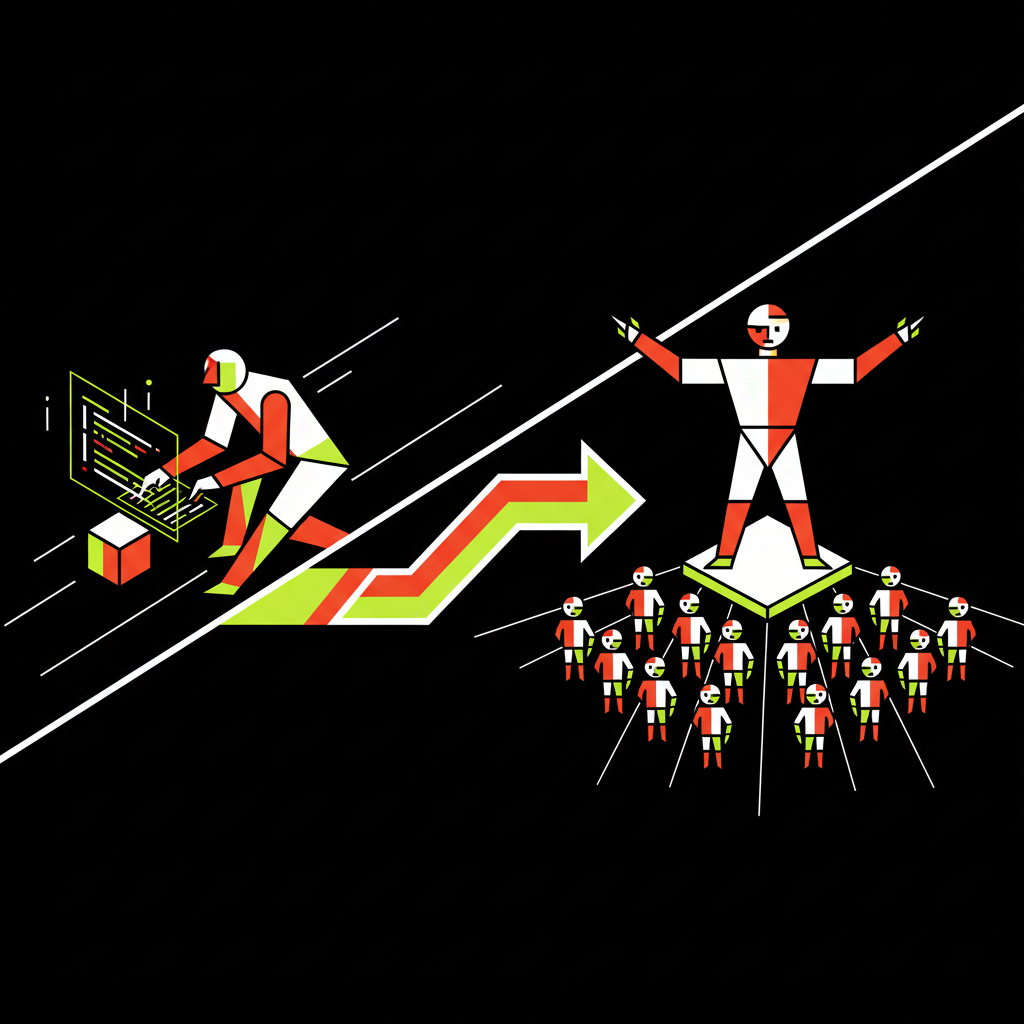
A personal observation from daily work: My role has changed less than expected.
Before: Coordinate teams, discuss architecture, clarify questions, review results. Now: Orchestrate agents, define architecture, challenge results, validate decisions.
The activities remain remarkably similar. The difference is the team. Before, it consisted of human developers. Now, increasingly of AI agents. Many principles of good collaboration remain constant.
Why skepticism is understandable
The skeptical reactions back then were by no means irrational. Software development is a discipline strongly shaped by experience. Anyone who has learned over years that quality takes time understandably reacts critically to claims of drastic productivity increases.
Technological transitions initially seem unrealistic — until practical experience creates new reference points.
The actual change is still ahead
From my perspective, AI doesn't replace developers. But it shifts the discipline's center of gravity: less focus on implementation, more focus on system understanding, greater importance of architectural decisions.
Software development becomes less craft-oriented and more conceptual.
Conclusion
The decisive question today is no longer: Can AI program? But rather: How do you sensibly organize software development when implementation is massively accelerated?
Those who view AI only as enhanced autocomplete underestimate its potential. Those who believe developers will become obsolete underestimate the complexity of software development.
The future probably belongs to hybrid teams — humans who understand systems, and agents who implement them at high speed. How quickly this perspective takes hold will be decided by practical experience — not by discussions.